Uncategorized
The Winter Midge Game on a Tailwater
A tailwater does not really have a winter. The water leaving the bottom of a dam comes out at much the same temperature in January as in July, and that steadiness is why trout below dams keep feeding when every freestone river nearby has shut down.
What they feed on is midges. Chironomids hatch on tailwaters twelve months a year, in numbers that are hard to believe until you have watched a February afternoon come alive with them. A trout that has spent three months eating almost nothing else is not a difficult fish to catch. It is a fish that wants one specific, very small thing, presented well.
Three stages, three ways to fish
The midge life cycle gives you three distinct pieces of water to fish, and knowing which one you are on saves a lot of wasted casting.
Larva — deep, and most of the day
The larva is a thin worm-like thing living in the silt, and it is what trout eat by default when nothing is hatching. This is your morning fly and your bad-weather fly. Fish it on the bottom, dead drift, under an indicator set at roughly twice the depth of the water.
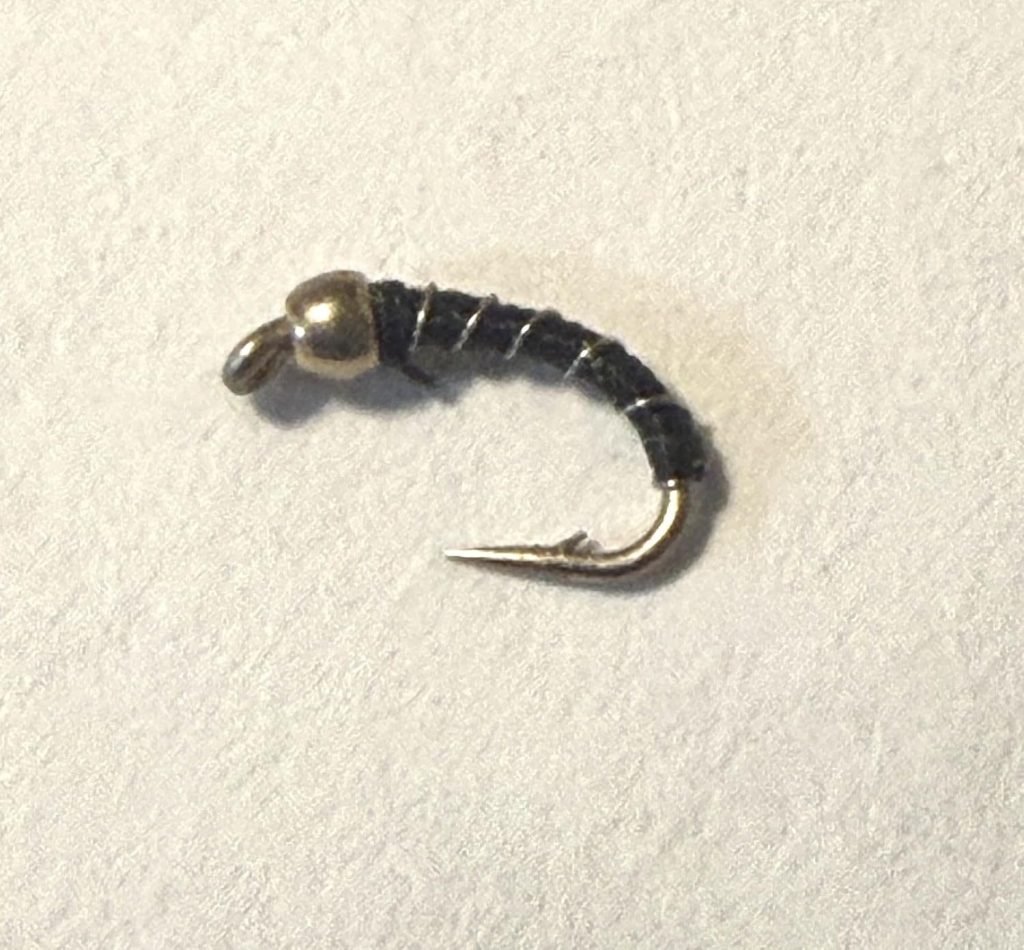
The Zebra Midge is the whole category in one pattern: thread, wire, a bead. Three materials, and it consistently beats flies with fifteen. Black and brown are the naturals; red, purple and white are what you switch to when the naturals stop producing on heavily fished water. The Black Beauty is the other one worth carrying — Pat Dorsey’s tailwater pattern, deliberately plain, and the reason a lot of anglers stopped over-thinking winter nymphs.
Pupa — the top few feet, when it starts
When an emergence begins, the pupae rise through the column carrying a bubble of gas under the skin. That is the vulnerable moment, and trout time their feeding to it precisely. Move your flies up. If the indicator was six feet above the point fly, bring it to two or three.
The Massacre Midge is a clean pupa imitation with a flash collar at the thorax standing in for that gas. On stained water or in the flat light of a winter afternoon, the White Bead Head Zebra Midge trades naturalism for visibility and is often the better call — a midge is small enough that trout will commit to an odd colour without much scrutiny. Add an emerger wing and you get the White Zebra Midge Sparkle Wing, which represents the pupa at the exact moment of hatching.
One presentation trick worth more than any fly change: let the drift swing up at the end of the run. Stop the indicator, let the current lift the flies through the column, and hold on. That rise imitates an emerging pupa better than anything you can do with a dead drift, and a lot of winter fish eat on the lift.
Adult — the surface, and only sometimes
Single midge adults are too small to interest most trout, so they wait for the naturals to clump together on the surface in mating balls. When you see steady, quiet sips in flat water and cannot work out what is being eaten, that is usually what is happening.
Griffith's Gnat is the answer — peacock herl with grizzly hackle palmered over it, a scruffy little ball that reads as several midges tangled together. It is one of very few dry flies worth carrying in January. Fish it on 6X or 7X to a specific rising fish, with a drift that has no drag in it at all.
Rigging that works in the cold
A two-fly rig covers two stages at once and is the standard for a reason. Put the heavier fly on point and something smaller and softer on the upper dropper, eighteen inches above.
Two Zebra Midges in different colours on the same rig is a completely legitimate way to fish a tailwater in winter — it lets the fish tell you which colour they want without you changing patterns every ten minutes. If you need more weight to reach the bottom, a Copper John on point does the job without adding split shot, and is a credible fly in its own right.
Fish the water winter fish actually use
Cold trout do not sit in fast riffles. They move into deeper, slower water — the tail of a pool, the soft inside of a bend, anywhere the current is gentle enough that holding position costs almost nothing. They also stack up, so a hooked fish often means several more in the same square metre.
Fish slowly and thoroughly. Cover one run properly rather than three quickly. And do not start at dawn: the best hour on a winter tailwater is usually somewhere between eleven and three, when the water has taken what warmth the day has to offer and the midges come off.
The short version
- Deep with larvae in the morning, higher in the column once pupae start moving.
- Let the drift swing up at the end — the lift catches fish.
- Quiet sips in flat water mean clustered adults, not singles.
- Two midges in different colours beats guessing.
- Slow, deep, soft water. Late morning to mid-afternoon.